


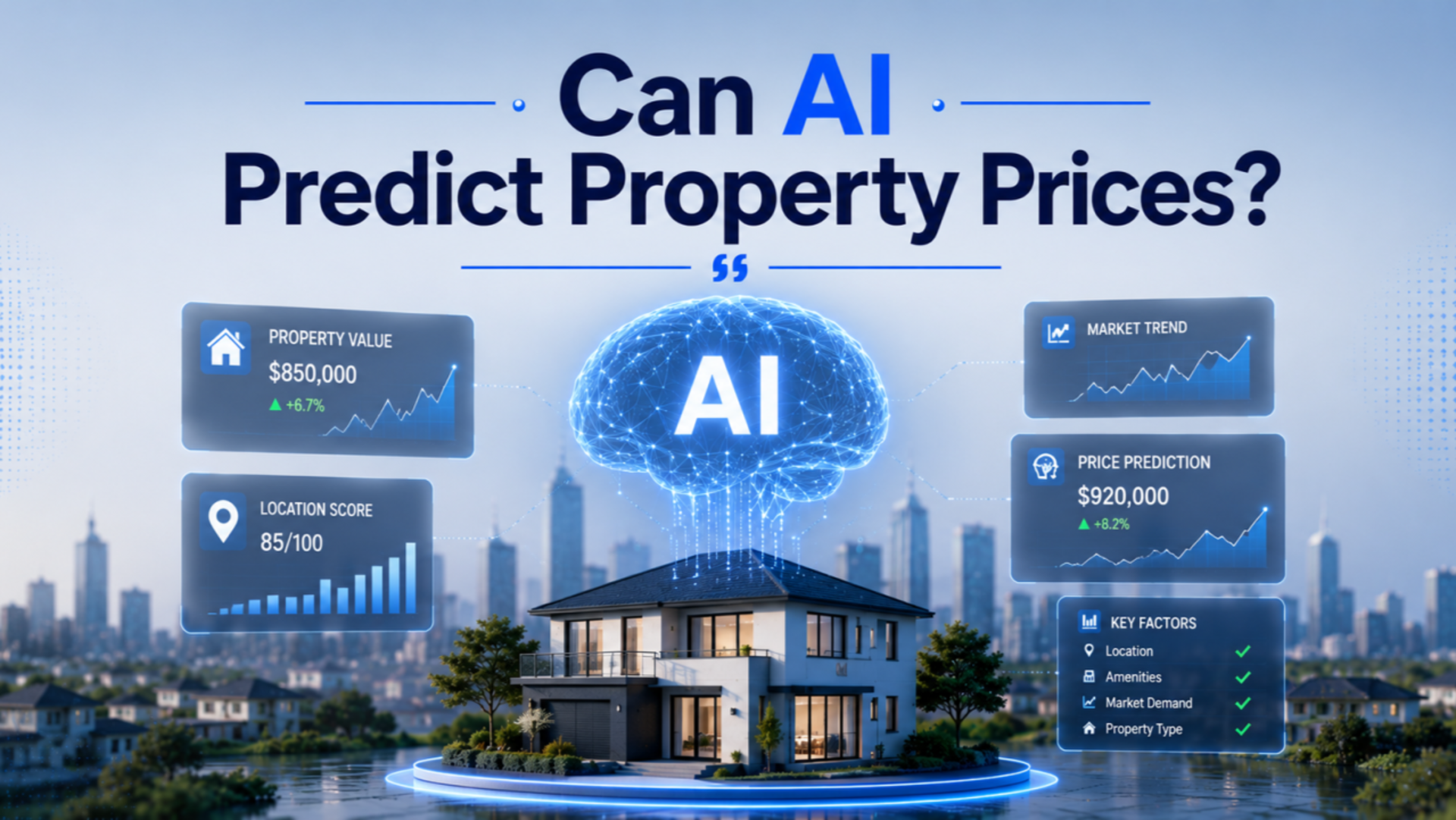
Artificial Intelligence is transforming real estate investing. From predicting property price movements to identifying emerging markets, AI can process vast amounts of data faster than any human analyst. Investors increasingly rely on AI tools to evaluate opportunities and forecast future appreciation.
But there is one important limitation.
AI can estimate future property prices, but it cannot reliably predict the three factors that often determine whether an investment becomes highly profitable or disappoints investors.
In real estate, returns are influenced by realities that frequently exist beyond historical data and mathematical models. Among them, three factors stand out: developer execution, local regulatory and political decisions, and infrastructure execution.
These are the areas where investors often make or lose the most money.
AI Is Good at Predicting Trends, Not Real-World Outcomes
AI works by analyzing historical information. It studies transaction data, economic indicators, supply-demand patterns, interest rates, and market cycles to estimate future property values.
This can be extremely useful for identifying promising investment corridors and understanding broader market trends.
However, real estate is not driven by numbers alone.
A location may appear attractive on paper, but the actual return depends on whether projects get completed on time, whether regulations change unexpectedly, and whether promised infrastructure becomes reality.
These factors can significantly influence returns regardless of what AI models predict.
Why Property Appreciation Alone Doesn't Determine Investment Success
Many investors focus exclusively on projected appreciation.
If an AI platform predicts that property values in a particular location could rise by 20% over the next few years, it is easy to assume that the investment is a safe bet.
The reality is more complex.
Property returns depend on execution, market confidence, and the ability of the surrounding ecosystem to support long-term demand.
A location can have excellent growth forecasts yet deliver disappointing returns if developers fail to execute projects, infrastructure gets delayed, or policy changes affect buyer sentiment.
This is why experienced investors look beyond price predictions.
1. Developer Execution and Financial Realpolitik
One of the most important factors affecting real estate returns is the ability of a developer to execute and deliver what was promised.
Many AI systems analyze project launches, historical pricing, and market demand. However, they often cannot accurately evaluate a developer's financial strength, internal challenges, or execution capabilities.
A project may have an attractive location and strong appreciation potential, but if construction slows down due to funding constraints, management issues, or poor execution, investor returns can suffer significantly.
Financial realities also matter.
Developers face changing borrowing costs, cash-flow pressures, sales targets, and market conditions. These factors influence project timelines and delivery schedules in ways that are difficult to model using historical data.
The difference between a developer who consistently delivers on time and one who struggles with execution can have a far greater impact on returns than a predicted increase in property prices.
For investors, assessing developer credibility remains one of the most important steps in the decision-making process.
2. Hyper-Local Regulatory and Political Whims
Real estate is one of the most regulated industries in the world.
While AI can analyze existing regulations, it struggles to predict sudden policy shifts, local government decisions, and political developments that can directly affect property values.
A zoning change, revised building norms, environmental restrictions, taxation updates, or development approvals can dramatically alter the investment potential of a location.
These decisions are often highly localized.
What happens in one micro-market may not happen in the neighboring area, making prediction even more difficult.
Political priorities can also change with elections and administrative transitions. A development corridor that appears promising today may face delays or policy adjustments tomorrow.
For this reason, investors who understand local governance, planning authorities, and regional development policies often gain insights that data models cannot provide.
In real estate, local politics can sometimes influence returns as much as market fundamentals.
"3. Infrastructure Execution
Infrastructure has historically created some of the biggest wealth-generation opportunities in real estate.
Metro lines, highways, airports, business districts, technology parks, and connectivity improvements often increase both demand and property values.
Because of this, many AI-based forecasting tools factor infrastructure announcements into their growth predictions.
The challenge is execution.
There is a major difference between announced infrastructure and completed infrastructure.
Projects frequently encounter delays due to approvals, funding issues, land acquisition challenges, legal disputes, or changing government priorities.
A metro line expected to become operational in three years may take significantly longer. During that period, property appreciation may not match investor expectations.
AI can identify announced projects, but it cannot consistently predict how efficiently they will be implemented.
Investors who verify project progress and execution timelines typically make more informed decisions than those who rely solely on future infrastructure promises.
AI Is a Research Tool, Not a Replacement for Judgment
Artificial intelligence has become an important part of modern real estate investing.
It helps investors process information faster, compare locations, and identify opportunities that deserve attention.
However, successful investing still requires human judgment.
The best investors combine AI-driven insights with on-ground research, developer due diligence, regulatory awareness, and infrastructure verification.
Technology can highlight opportunities, but experience helps separate realistic opportunities from optimistic projections.
Common Mistakes Investors Make
Many investors rely too heavily on future price forecasts without examining the factors that actually drive returns.
A common mistake is choosing projects based solely on appreciation estimates while ignoring developer track records.
Others assume announced infrastructure projects will automatically create growth without evaluating execution risks.
Some investors also overlook local regulatory changes and political developments that can influence future demand.
Real estate investing becomes far more effective when investors evaluate both data and real-world execution.
Conclusion
AI is becoming increasingly powerful in real estate analysis, but investment success still depends on factors that algorithms struggle to predict.
Developer execution and financial realities, hyper-local regulatory and political decisions, and infrastructure execution often have a greater impact on returns than price forecasts alone.
The investors who consistently outperform are not necessarily those with the best predictive models. They are the ones who understand how these real-world factors shape market outcomes.
Property prices may be predicted by AI.
Investment returns are still determined by execution.
Tags
RealHubb Team
Real Estate Expert · RealHubb Ventures
RealHubb Team is a seasoned real estate advisor at RealHubb, dedicated to helping families find their dream homes in Bangalore, Hyderabad, and Chennai.
Frequently Asked Questions
Can AI accurately predict property prices?▾
AI can estimate property prices by analyzing historical sales data, market trends, demand, and economic indicators. While these predictions can identify promising investment locations, they are not guarantees of future returns. Real estate markets are also influenced by developer performance, government policies, and infrastructure execution, which AI cannot reliably predict.
Can AI predict real estate investment returns?▾
No, AI cannot accurately predict total real estate investment returns. While it can forecast potential price trends, actual returns depend on factors such as developer execution, regulatory changes, infrastructure delivery, and market sentiment. Investors should use AI as a research tool rather than the sole basis for investment decisions.
Why is developer reputation important in real estate investing?▾
Developer reputation is important because timely project delivery and construction quality directly affect investment outcomes. Even in high-growth locations, delays or financial challenges can reduce returns and buyer confidence. Reviewing a developer's track record, financial stability, and completed projects is an essential part of property due diligence.
How do government policies affect property prices?▾
Government policies can significantly influence property values through zoning regulations, infrastructure approvals, taxation, and land-use changes. These decisions often impact specific micro-markets and may alter demand or development potential. Since policy changes are difficult to predict, investors should monitor local regulations alongside market trends.
Why is infrastructure execution more important than infrastructure announcements?▾
: Infrastructure announcements create expectations, but completed projects create value. Delays caused by approvals, funding, or land acquisition can postpone the benefits investors anticipate. Evaluating the actual progress of roads, metro lines, airports, and business parks provides a more realistic view of a property's long-term growth potential.
What are the biggest limitations of AI in real estate investing?▾
AI performs well at analyzing historical data but cannot reliably predict human decisions, policy changes, project execution, or unexpected market events. These real-world factors often determine whether a property delivers strong returns. Combining AI insights with on-ground research leads to more informed investment decisions.
Should investors rely only on AI when buying property?▾
No, AI should support—not replace—investment decisions. While it helps compare markets and identify trends, investors should also assess developer credibility, legal approvals, infrastructure progress, and local market conditions. Combining technology with independent due diligence reduces risk and improves decision-making.
What common mistakes do investors make when using AI for real estate?▾
: A common mistake is relying only on AI-generated price forecasts while ignoring factors such as developer quality, project execution, and regulatory risks. Investors also tend to assume announced infrastructure projects will be completed on schedule. A balanced approach that combines data with practical research usually leads to better outcomes.
How can investors use AI effectively for real estate research?▾
AI is most effective for identifying growth corridors, comparing locations, analyzing market trends, and processing large datasets quickly. It can help narrow investment options, but every opportunity should still be verified through site visits, legal checks, and developer due diligence before making a financial commitment.
What factors influence real estate returns more than AI predictions?▾
: Developer execution, local regulatory decisions, and infrastructure execution often have a greater impact on investment returns than AI price forecasts. These factors determine whether projects are delivered on time, demand continues to grow, and promised infrastructure becomes operational. Successful investors evaluate these fundamentals alongside AI-generated market insights.